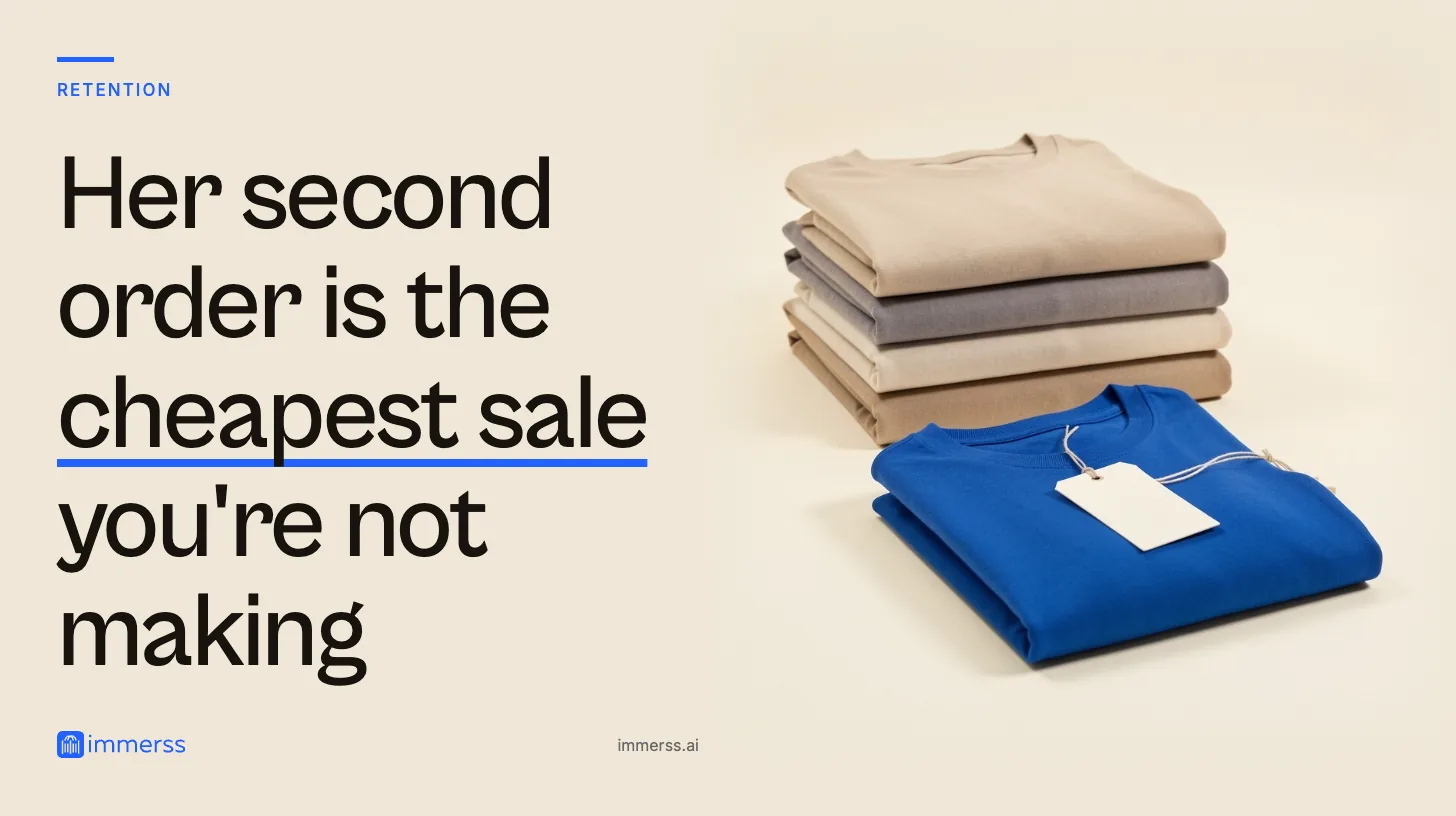
The Second Order Is the Cheapest Sale You're Not Making
Your returning customer has already settled price, trust and delivery. She's stuck on something else entirely, and most stores greet her like a stranger.
Ask most store owners where growth comes from and you’ll hear about traffic, ads, conversion rate. Ask about repeat customers and you’ll usually hear about a loyalty program, or a plan to start one.
Both answers skip the thing sitting between them: a customer who already bought once, already knows your prices are acceptable, already knows the delivery works — and who, when she comes back, gets exactly the same experience you show a total stranger.
What the first order settled, and what it didn’t
A first-time buyer is running an evaluation she can’t complete from outside. She doesn’t know whether your product matches its photographs, whether the packaging is careful, whether anyone answers when something’s wrong. So she buys one thing to find out.
If that goes well, four questions are permanently closed: is this store real, is the quality what it looked like, does delivery work, are the prices acceptable. Those were the blockers on order one, and most conversion advice is about resolving them.
Here’s what nobody follows: once those close, a different blocker takes their place.
She doesn’t know what else you have, or which of it is for her.
That’s not a trust problem or a price problem. It’s a relevance problem, and it needs a different tool.
What your returning customer actually sees
Picture a store selling eleven candle scents. A customer bought the amber one in March, liked it, burned it down over five weeks.
In May she thinks — unprompted, without any email from you — that she’d buy another. She types your brand name and lands on your homepage.
She gets the same hero banner she saw in March. The same six bestsellers. The same four categories.
She can’t remember what the one she liked was called. She opens the candle category, finds eleven scents with evocative names and no indication of which is nearest to what she had, and decides not to gamble $34 on a guess. She closes the tab intending to come back when she has more time.
Nothing went wrong. The site worked. She left because she couldn’t answer a question your store never offered to help with.
Four changes, in order of effort
1. Capture what the first order was for.
If you learn one thing about a first-time customer, learn the occasion or the problem — a gift, a big room, sensitive skin, a beginner. That single fact is the input to every future recommendation you’ll ever make to her.
Most stores never capture it, because the checkout doesn’t ask and nobody talks to the customer. A pre-purchase conversation produces it as a by-product: a shopper who asks “will this work in a big room” has just told you what she’s solving for.
2. Write down how your range relates to itself.
For each significant product, two or three plain lines: what pairs with it, what the natural next purchase is, which product is the upgrade and which is a sideways move, who should buy something else instead.
This is the most reusable asset a small store can create, and it almost never exists in written form. It lives in the head of whoever works the markets or answers the phone. Written down, it powers product pages, post-purchase messages and your answering layer — and it gives AI assistants something to reason with when someone asks them for a recommendation.
3. Make a returning customer’s arrival different from a stranger’s.
Not a popup. Something that names what she bought and proposes a specific next item with a reason attached.
“If the amber is running low — most people who liked it go to the fig next, or the same amber in the larger size if you’re burning it in a big room.”
That sentence is worth more than a discount code, and it costs nothing. The bar here is unusually low, because the current state in most stores is nothing at all.
4. Time your reappearance to the product, not the calendar.
The verdict on a first order doesn’t form at delivery. It forms as the thing gets used, washed, worn, or run out of. A candle burns down in five weeks. A sweater is judged after the third wash.
A “come back” email seven days after dispatch arrives before the experiment has finished. One timed near natural depletion arrives when the customer has a fresh, evidence-based opinion and nowhere to put it.
Work out how long your product actually lasts. It’s usually something the founder knows by instinct and has never written down.
Why a loyalty discount isn’t the answer here
Points and tiers do something, and they plateau quickly, because a discount answers a price objection and your returning customer doesn’t have one. She already paid your prices and didn’t regret it.
Ten percent off forty products she can’t choose between is not help — it’s a cheaper version of the same problem. And discounting the second order teaches your best customers that waiting produces a better price.
A diagnostic you can run today
Split your repeat orders into two piles: exact re-orders of the identical item, and purchases of something different.
If almost every repeat is an exact re-order, your customers are coming back despite your catalog rather than through it — buying the one product whose name they remember, because it’s the only decision they can make unaided. That’s a relevance problem hiding behind a respectable-looking repeat rate.
Repeats spread across the range mean something in your store is doing the introducing.
What to measure
- Repeat rate at 90 days, tracked as a trend rather than a single number.
- Share of repeats that are a different product — the relevance signal above.
- Time from first delivery to second order, compared against how long your product actually lasts. A gap much longer than the usage cycle means she came back late because nothing prompted her.
- Second-order AOV versus first. It should be equal or higher; lower usually means she defaulted to the safe re-order rather than being introduced to anything.
Deliberately not a target: loyalty program enrollment. It measures sign-ups, not purchases.
Where Immerss fits
Immerss puts an AI sales agent on your product pages that answers shoppers’ specific questions from your own catalog, and every conversation stays visible to you. What a shopper told the agent she was solving for is on record — the input the second-order recommendation needs, and the one most stores never capture.
When a question needs a person, one tap brings a real advisor onto live video who can show the product and add it to the cart. Customer stories show how stores use it, and the setup guide walks through the agent on Shopify.
Immerss installs on Shopify, WooCommerce and Salesforce, and it’s free to start — get started.
The returning customer already knows where to find you, already trusts the delivery, already accepted the price. She is structurally the easiest sale in your business.
Right now she’s getting the same homepage as someone who has never heard of you.